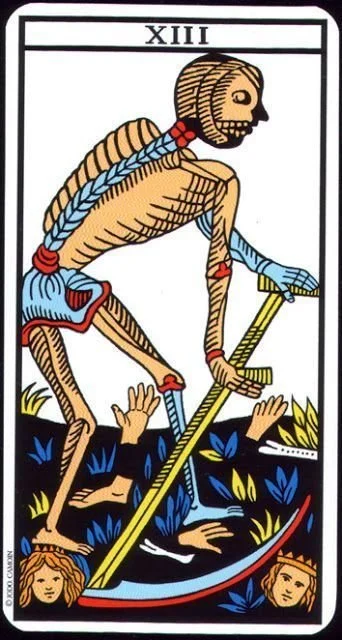
Jodorowsky Ben Doav CBD Tarot
Endings are something most of us are not very good at. We hang on to jobs, relationships, homes and old versions of ourselves long after they have stopped nourishing us, partly because letting go feels like a kind of death. Which is exactly why the Death card has such a terrible reputation, and why, as people get ready for Halloween parties and Samhain rituals this week, I think it is such a useful companion.
Samhain falls on 1 November, with Halloween as its eve. In the old Gaelic calendar it marked the end of the harvest and the beginning of winter, the darker half of the year. Cattle were brought down from the summer pastures, the herds were counted, and the animals that wouldn't make it through the winter were slaughtered. In the early Irish stories it is also the time when the fairy mounds stand open and the Otherworld comes close. In the wheel of the year, it is a liminal time when the veil between the worlds is thin.
We are at a threshold. The harvest is in. What can be carried through the winter is kept, and what can't is let go.
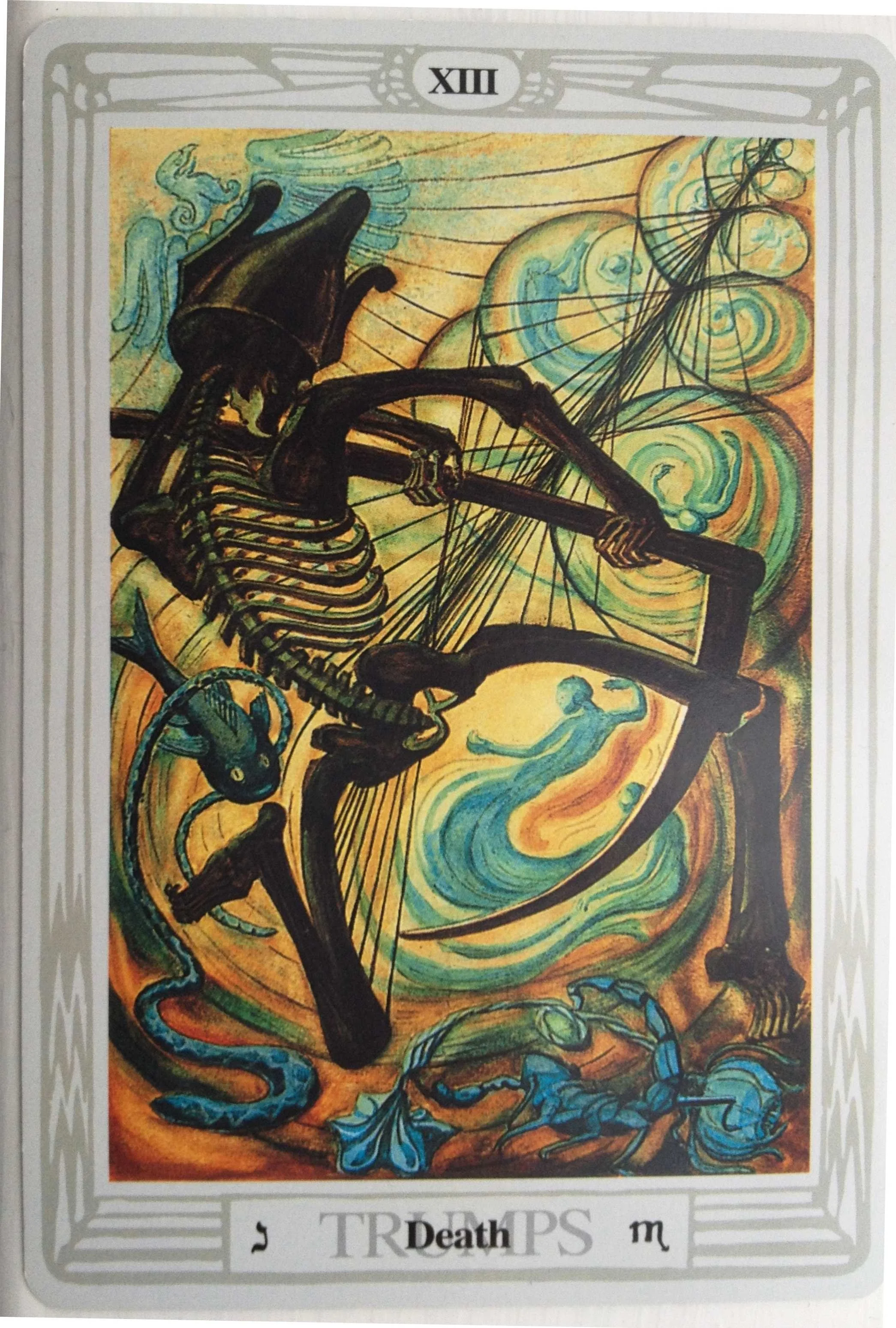
Thoth Tarot
If you are carving a lantern, building a fire or setting up an altar this week, you are already standing at the threshold. The Death card is a good thing to bring with you.
In the Tarot de Marseille the thirteenth card has no name. The number is there, but the title strip is left empty, which is why the French tradition calls it l'Arcane sans nom, the nameless arcanum. (One or two old decks do print La Mort, but most don't.) Yoav Ben-Dov, who studied tarot with Jodorowsky and restored the 1760 Conver deck, calls his approach the open reading: describe what is actually on the card before interpreting it. So, looking openly. A skeleton is at work with a scythe. The ground is black and full of heads, hands and feet, and among them something green is coming up. Flesh, clothes and rank have all gone; what is left is bone. Ben-Dov reads the card around endings, and cutting away what is no longer needed so that what is essential remains. He is also clear that it should not be used to predict anyone's death.
Other writers come at the card from different angles but land in a similar place. The Rider Waite deck replaced the skeleton with a horseman carrying "a black banner emblazoned with the Mystic Rose, which signifies life", with "the sun of immortality" shining between two pillars on the horizon. In the Golden Dawn tradition the card belongs to Scorpio, and Aleister Crowley wrote that "when the Sun enters Scorpio (23 October to 21 November) it is the death of the year".
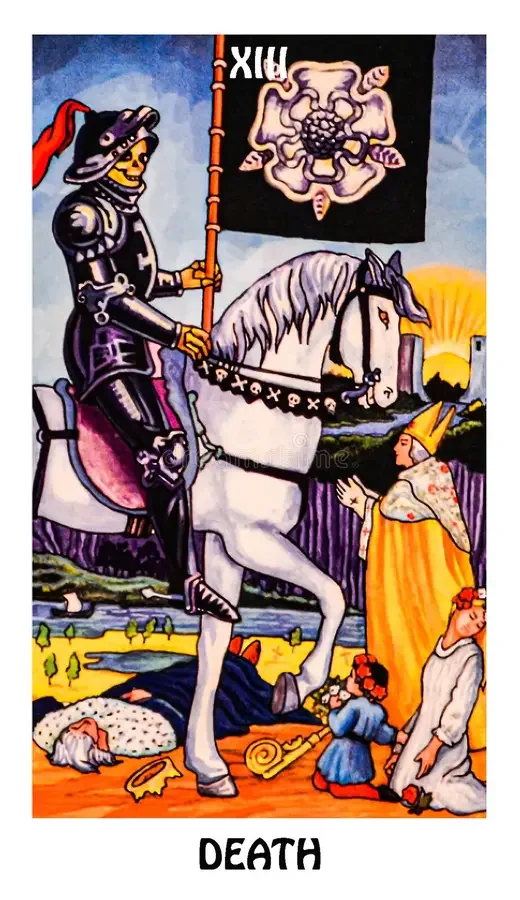
Rider-Waite
Jodorowsky and Marianne Costa point out that the Marseille skeleton is flesh-coloured, the colour of living things, and that XIII, which has a number but no name, mirrors the Fool, who has a name but no number. The skeleton could almost be the Fool seen by X-ray: the same traveller, stripped back to structure, still walking. Rachel Pollack, in Seventy-Eight Degrees of Wisdom, focuses on letting go rather than on the transformation that follows it. She also notices that in the Rider Waite card only the child faces Death without fear, holding out flowers.
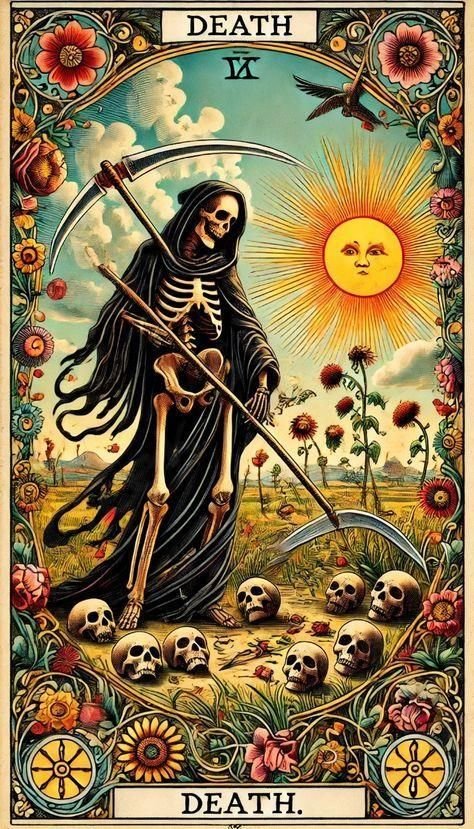
Death cuts away
In the journey of the major arcana, Death comes between the Hanged Man and Temperance. The Hanged Man is suspended upside down, waiting. Death cuts away and then Temperance begins pouring the waters from one vase to the other, distilling something new. It is a useful sequence to hold in mind when we are in the middle of an ending: the cutting is only one stage in the story.
In narrative coaching I often ask clients to apply what they see in a card, or in their own metaphors, to the situation they have been exploring. So at this end of season try this: Take the card out of the deck, prop it up where you can see it, and describe it out loud before you interpret anything. Then ask yourself: what has this year actually produced? What won't make it through the winter, however much I feed it – a habit, a role, an old story about myself that has stopped being true? When that is cut away, what is left to work with? And are any green shoots already coming up in the cleared ground, however small?
Whether you are marking the night with a ritual, a bonfire or trick-or-treating with your kids, I invite you to find time to sit with the card this Samhain. Where is the harvest already in, and what is ready to be let go? Where you are headed in this liminal time may not yet be clear or have a name - that's all right - neither does the card.
Further reading
Ben-Dov, Yoav. Tarot: The Open Reading (2013), reissued as The Marseille Tarot Revealed (Llewellyn, 2017).
Waite, A. E. The Pictorial Key to the Tarot, XIII Death (1910; sacred-texts mirror).
Crowley, Aleister. The Book of Thoth, XIII Death (1944); and A Treatise on Astrology (1916–17).
Jodorowsky, Alejandro and Marianne Costa. The Way of Tarot (Destiny Books, 2009); discussion of Arcanum XIII.
Pollack, Rachel. Seventy-Eight Degrees of Wisdom (1980; revised Thorsons edition 1997).
Tarot of Marseilles and Samhain, Wikipedia.